You may be thinking of building or refurbishing a playground for children. Whether it is a private play area or a public play park, you will need to consider the surfaces you intend to use for optimum child safety.
One of the primary considerations when it comes to areas dedicated to child’s play is safety. Other considerations are budget, durability, maintenance cost and requirements, and accessibility.
We put the most common playground surfacing materials to the test to determine which would be the safest and most cost-effective choice, given the above criteria.
Unitary Surfaces
Unitary surfaces form one cohesive unit, as opposed to those that comprise loose elements to fill the surface area.
Poured Rubber Surfaces
A popular material for playground surfaces, Poured Rubber Surfaces are the safest recommended surface for children’s playgrounds, meeting the American Society for Testing and Materials safety standards. Accessibility for wheelchairs is seamless due to the smooth, flat surface it provides.
Also, poured rubber surfaces offer a durable and long-lasting solution that requires little maintenance apart from cleaning as needed. However, the initial cost of installation requires skill and experience and can be rather pricey.
That said, this solution is available in multiple colors and designs, which allows for a degree of flexibility and creativity.
Bonded Rubber Surfaces
Bonded Rubber Surfaces are made of shredded recycled rubber that is cleaned, dyed, and compacted to form a unified surface.
The surface bears a texture but still offers all the safety, maintenance, and accessibility advantages of the poured rubber surface, but at a lower installation cost.
Tiles
Tiles can be in the form of rubber tiles, aquatic tiles, or vulcanized tiles which are rubber tiles that have been treated to make them harder.
While they offer the benefits of being easy to install and repair, these kinds of tiles generally offer slightly less shock absorption than the poured rubber surface. They are, however, highly durable and easy to clean and can have additional layers installed below to increase the rate of absorption slightly.
Synthetic Turf
A great natural-looking solution, Synthetic Turf meets the ASTM standards relating to shock absorption and safety when installed with the correct lining. The turf is also easily accessible by wheelchair.
While the cost of installation is high, the long-term maintenance costs are generally low.
However, some disadvantages to consider are that the nature of turf could allow for the accumulation of bacteria, making it unsanitary, and may create a tripping hazard if not installed correctly.
Loose-Fill Surfaces
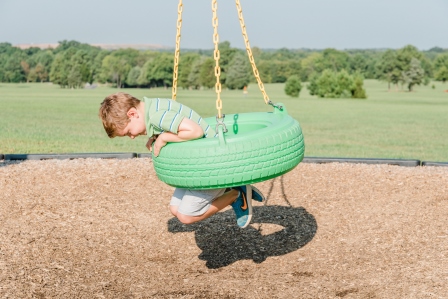
Loose-fill surfaces include the likes of Engineered Wood Fiber (EWF), Loose-fill Rubber, as well as Sand and Gravel.
They offer a less expensive installation option than unitary surfaces, making them a popular choice. However, they are not necessarily the most cost-effective or the safest in the long run.
The primary issue with loose-fill surfaces is that the particles make up the fill shift as the children play, which reduces the depth in high traffic areas, thus compromising the safety at these points. Therefore, constant raking and evening out of particles are needed to maintain safety standards for the children.
A 2000 study carried out by the Society for Advancement of Violence and Injury Research (SAVIR) showed the results of a test done to measure how well different loose-fill surfaces absorbed the impact of a potential fall from different heights.
Pea gravel was the worst performer, with sand, wood fibers, and wood chips not too far behind. On the other hand, Loose-fill Rubber can meet the ASTM standards, but only when properly installed and maintained.
For more read blogs :- https://austin-stanfel.blogspot.com/2022/04/5-details-you-shouldnt-overlook-in.html
 Austin Stanfel